
Simulating Age-Period-Cohort Data
Volker Schmid
2026-08-31
Source:vignettes/largevignettes/simulation.Rmd
simulation.RmdThis vignette simulates age-period-cohort data from known,
hand-specified age, period and cohort effects, fits bamp()
to the simulated cases, and checks that the fitted effects recover the
true ones – a good way to sanity check the method, or to plan how much
data a study design would need. For a first introduction to
bamp(), see vignette(“bamp”, package=“bamp”); for
other model specifications, see vignette(“modeling”,
package=“bamp”).
Specifying the true effects
We first fix the three true effects on the log-odds scale; each is centred (mean zero) since only their shape, not their level, is identified (see vignette(“modeling”, package=“bamp”)). The age effect is an increasing, concave curve:

The period effect is V-shaped: it falls for the first half of the observed periods, then rises again over the second half:
period=25:1
period[13:25]<-13:25
period<-period/5
period<-period-mean(period)
plot(period, type="l")
The cohort effect falls for the earliest cohorts, rises through the
middle ones, then slightly falls for the most recent cohorts. With
periods_per_agegroup = 5 and 10 age groups spanning 25
periods, there are
periods_per_agegroup * (10 - 1) + 25 = 70 cohorts:
periods_per_agegroup=5
number_of_cohorts <- periods_per_agegroup*(10-1)+25
cohort<-rep(0,70)
cohort[1:20]<-(19:0)
cohort[21:40]<- (1:20)/2
cohort[41:70]<- 10
cohort=cohort-(1:70)/10
cohort<-cohort/10
cohort<-cohort-mean(cohort)
plot(cohort, type="l")
Simulating data from the true effects
apcSimulate() combines an intercept (here
-10, on the log-odds scale) with the three true effects and
a population of 1 000 000 per Lexis cell to draw simulated
case counts, returning cases and population
matrices just like the bundled apc data example:
simdata<-apcSimulate(-10, age, period, cohort, periods_per_agegroup, 1e6)
print(simdata$cases)
## [,1] [,2] [,3] [,4] [,5] [,6] [,7] [,8] [,9] [,10]
## [1,] 0 15 30 59 99 141 406 1197 3438 9608
## [2,] 5 8 27 52 96 116 285 863 2560 7111
## [3,] 0 6 23 41 72 113 222 621 1944 5172
## [4,] 1 7 16 45 50 99 147 495 1363 3847
## [5,] 1 6 13 26 57 76 116 321 997 2770
## [6,] 2 6 11 21 33 54 96 261 750 2013
## [7,] 2 2 9 24 36 53 70 163 572 1569
## [8,] 1 1 12 22 35 52 79 151 386 1185
## [9,] 1 2 8 26 29 42 66 123 279 830
## [10,] 1 2 2 17 16 30 53 94 204 601
## [11,] 1 2 4 23 17 39 49 55 159 402
## [12,] 0 2 2 12 14 37 27 62 105 330
## [13,] 0 3 4 10 22 18 36 40 75 252
## [14,] 2 0 4 7 23 30 37 56 99 278
## [15,] 0 3 6 12 22 32 59 97 124 289
## [16,] 0 2 7 12 27 49 67 93 118 309
## [17,] 0 1 5 7 39 63 90 125 145 353
## [18,] 1 4 3 20 44 65 97 149 210 359
## [19,] 2 3 12 23 55 99 122 205 297 392
## [20,] 0 7 6 21 70 117 186 262 352 417
## [21,] 0 7 20 27 66 134 210 303 431 578
## [22,] 1 5 20 38 83 168 279 396 525 673
## [23,] 2 6 19 45 121 208 330 513 665 917
## [24,] 2 5 20 60 125 242 471 604 839 1112
## [25,] 2 7 24 58 138 313 586 775 1049 1509Recovering the effects with bamp()
We fit a second-order random-walk (RW2) model to the simulated data:
simmod <- bamp(cases = simdata$cases, population = simdata$population, age = "rw2",
period = "rw2", cohort = "rw2", periods_per_agegroup =periods_per_agegroup)
print(simmod)##
## Model:
## age (rw2) - period (rw2) - cohort (rw2) model
##
## Effects: 5% 50% 95%
## intercept -10.013 -9.966 -9.923
##
## Deviance: 252.83
## pD: 40.63
## DIC: 293.46
##
##
## Hyper parameters: 5% 50% 95%
## age 3.148 7.788 16.062
## period 146.307 282.779 504.666
## cohort 991.512 1827.299 3301.015
##
##
## Markov Chains convergence checked succesfully using Gelman's R (potential scale reduction factor).
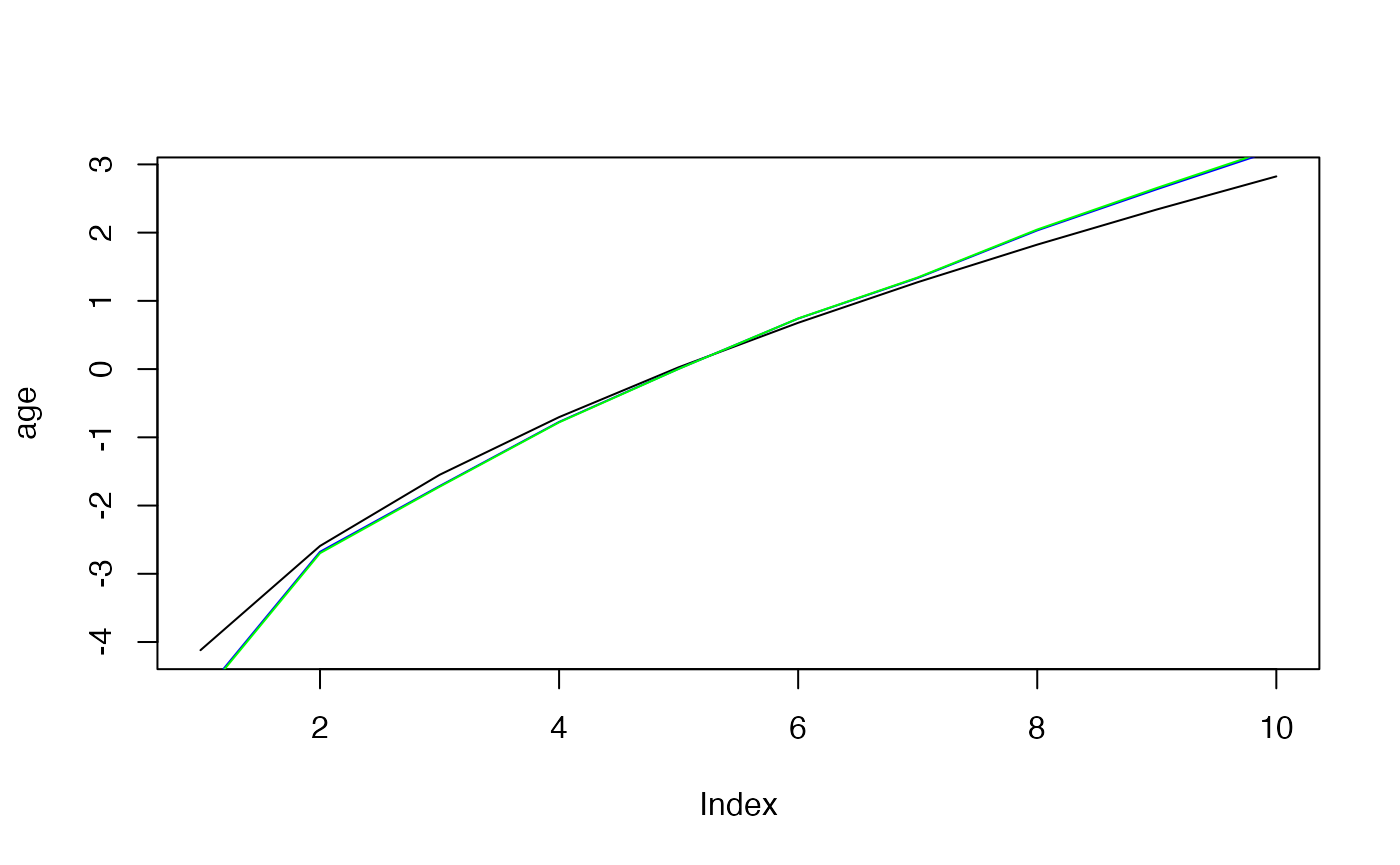
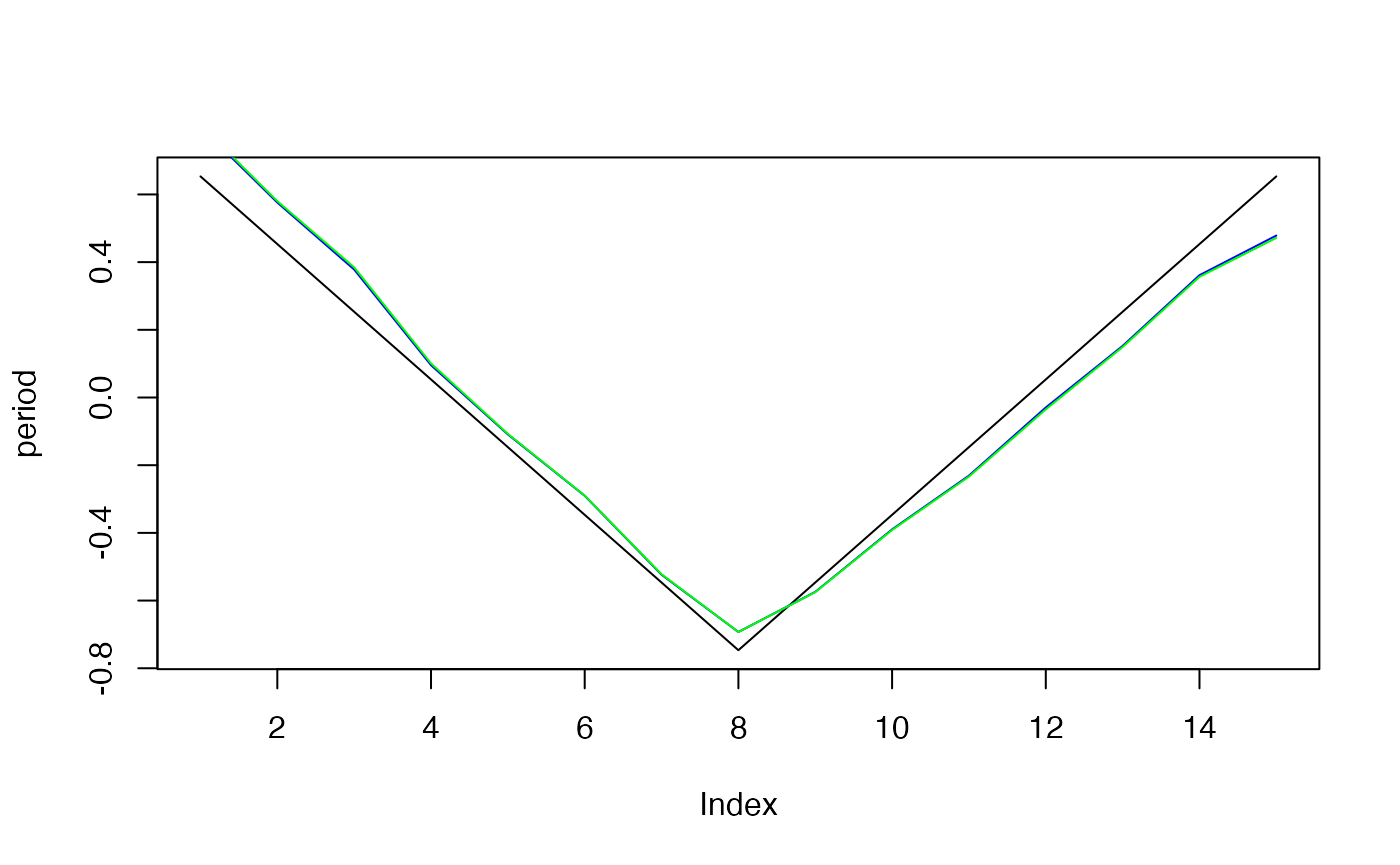
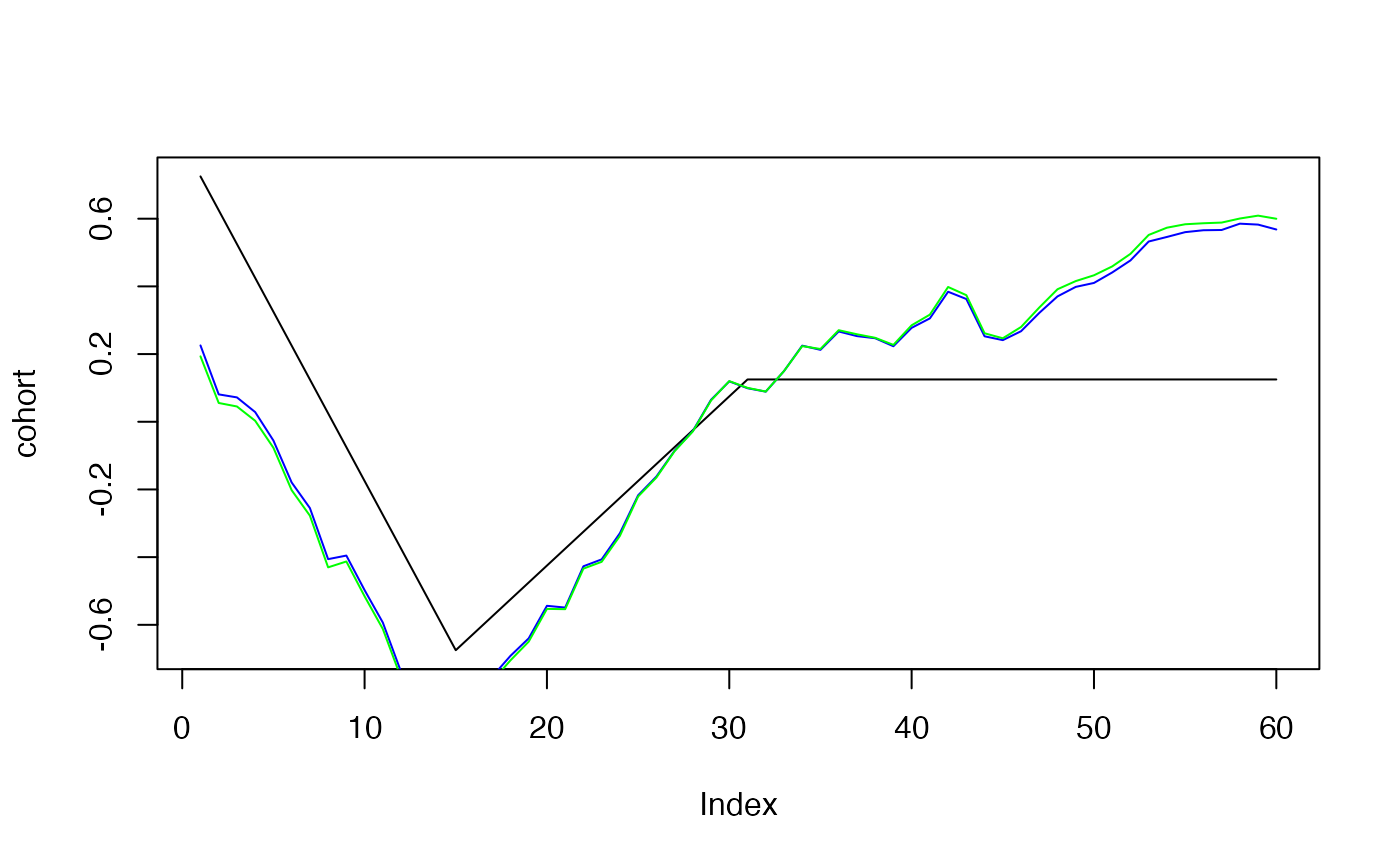
Since we know the true effects here (unlike with real data), we can
check directly how well bamp() recovered them: the black
line is the true effect, the blue line the fitted posterior median
(effects()). Because the age, period and cohort effects are
only identified up to a shared linear trend (see
vignette(“modeling”, package=“bamp”)), the recovered curves
show the same nonlinear (curvature) features as the truth, but are
linearly shifted relative to it.
Prediction
As in vignette(“prediction”, package=“bamp”), the fitted
random walks can be extrapolated to forecast cases for periods beyond
the simulated data – here 5 more, so the supplied
population array covers 30 periods (25 observed + 5
forecast) across the 10 age groups:
prediction<-predict_apc(simmod, periods=5, population=array(1e6,c(30,10)), quantiles=c(.1,.5,.9))Total predicted cases per period are shown with their median (solid points) and 80% credible interval (dashes):
plot(prediction$cases_period[2,], ylim=range(prediction$cases_period),ylab="",pch=19)
points(prediction$cases_period[1,],pch="–",cex=2)
points(prediction$cases_period[3,],pch="–",cex=2)
for (i in 1:30)lines(rep(i,3),prediction$cases_period[,i])
The period effect itself extends the same way into the 5 forecast periods:
plot(prediction$period[2,], type="l", ylim=range(prediction$period))
points(prediction$period[2,1:25])
for (i in 26:30)lines(rep(i,3),prediction$period[,i])
Period covariate
Finally, we refit the simulated data with a period covariate scaling the period effect (see vignette(“modeling”, package=“bamp”)). A period covariate is a positive multiplier, so it must be larger than zero.
simmod2 <- bamp(cases = simdata$cases, population = simdata$population, age = "rw1",
period = "rw1", cohort = "rw1", periods_per_agegroup = periods_per_agegroup,
period_covariate = cov_p)
print(simmod2)##
## Model:
## age (rw1) - period (rw1) - cohort (rw1) model
##
## Effects: 5% 50% 95%
## intercept -10.457 -10.411 -10.365
##
## Deviance: 252.35
## pD: 69.49
## DIC: 321.84
##
##
## Hyper parameters: 5% 50% 95%
## age 0.652 1.497 2.973
## period 2.497 4.336 7.118
## cohort 79.063 117.383 170.013
##
##
## Markov Chains convergence checked succesfully using Gelman's R (potential scale reduction factor).

prediction2<-predict_apc(simmod2, periods=5, population=array(1e6,c(30,10)), quantiles=c(.1,.5,.9))
plot(prediction2$cases_period[2,], ylim=range(prediction2$cases_period),ylab="",pch=19)
points(prediction2$cases_period[1,],pch="–",cex=2)
points(prediction2$cases_period[3,],pch="–",cex=2)
for (i in 1:30)lines(rep(i,3),prediction2$cases_period[,i])